Chemical safety is not only about storing chemicals in a cabinet or providing PPE. It starts with understanding the substance, how it is used, who may be exposed, and what controls are required to prevent harm.
Under the COSHH Regulation structure, the focus is on preventing or adequately controlling exposure to substances that are hazardous to health. A COSHH assessment should not be treated as just a document. It should be a practical review of the actual chemical activity at the workplace.
Identify the Hazardous Substances
The first step is to identify all substances used, stored, handled, generated, or disposed of at the site.
This may include:
✦ Chemicals
✦ Paints and solvents
✦ Cleaning agents
✦ Oils and lubricants
✦ Dust, fumes, vapours, gases, and mists
✦ Waste chemicals
✦ Substances generated during work activities
At this stage, the Safety Data Sheet should be reviewed to understand the health hazards, exposure limits, storage requirements, PPE requirements, first aid measures, and emergency actions.
Understand How Exposure Can Happen
Once the substance is identified, the next step is to understand how workers may be exposed.
Exposure can occur through:
✦ Inhalation of vapours, fumes, gases, or dust
✦ Skin contact with chemicals
✦ Eye contact due to splashes
✦ Accidental ingestion through poor hygiene practices
✦ Injection through cuts, punctures, or high-pressure equipment
This step is important because the control measures should be based on the actual route of exposure, not only on the chemical name.
Evaluate the Risk
The risk depends on the nature of the substance, quantity used, frequency of use, duration of exposure, method of handling, ventilation condition, and existing controls.
A small quantity of a highly toxic chemical may present a serious risk. Similarly, a commonly used cleaning chemical can also create health issues if used daily without proper ventilation or PPE.
The assessment should consider:
✦ Who is exposed
✦ How often exposure occurs
✦ How long the task takes
✦ Whether the area is ventilated
✦ Whether employees are trained
✦ Whether emergency arrangements are available
✦ Whether current controls are suitable
Apply Control Measures
COSHH follows the principle that exposure should be prevented wherever reasonably practicable. If exposure cannot be fully prevented, it should be properly controlled.
Control measures may include:
✦ Eliminate the hazardous substance where possible
✦ Substitute with a less hazardous chemical
✦ Use closed systems or enclosed processes
✦ Provide local exhaust ventilation or general ventilation
✦ Reduce the quantity stored or used
✦ Store chemicals based on compatibility requirements
✦ Ensure proper labelling of all containers
✦ Keep containers closed when not in use
✦ Provide spill kits and emergency response arrangements
✦ Provide suitable PPE as the last line of protection
✦ Train employees on safe handling and emergency response
PPE should not be the first control option. It should support other controls, not replace them.
Provide Information, Instruction, and Training
Employees must understand the chemicals they are working with. Training should be simple, practical, and related to the actual task.
Employees should know:
✦ What chemical they are using
✦ What the hazards are
✦ How exposure can happen
✦ What PPE is required
✦ What to do during spills or splashes
✦ Where the SDS is available
✦ How to store and dispose of chemicals safely
A COSHH assessment is effective only when employees understand and follow the controls.
Monitor and Review Controls
Controls should be checked regularly to ensure they remain effective.
This may include:
✦ Inspection of chemical storage areas
✦ Checking ventilation systems
✦ Reviewing PPE condition and suitability
✦ Monitoring spills or incidents
✦ Updating SDS files
✦ Reviewing chemical inventory
✦ Revising the assessment when chemicals or processes change
COSHH assessments should be reviewed whenever there is a change in substance, process, quantity, storage arrangement, incident, complaint, or legal requirement.
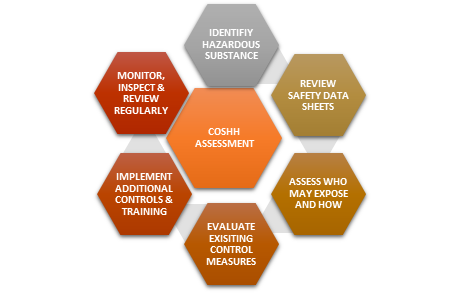
COSHH Assessment Flowchart
Risk of Not Conducting COSHH Assessment
Without a proper COSHH assessment, chemical hazards may remain uncontrolled.
This can lead to:
✦ Breathing problems due to vapour, fumes, gases, or dust
✦ Skin burns, irritation, or dermatitis
✦ Eye injuries from chemical splashes
✦ Unsafe chemical mixing
✦ Fire or toxic gas release due to incompatible storage
✦ Chemical spills and environmental contamination
✦ Poor emergency response during incidents
✦ Regulatory non-compliance and business interruption
What are we doing?
At EHS Management Consultants, we support organizations in preparing practical COSHH risk assessments based on actual workplace activities.
Our services include chemical inventory review, SDS review, exposure assessment, compatibility review, chemical storage inspection, PPE review, spill response planning, emergency preparedness review, and preparation of safe handling procedures.
We also help organizations improve chemical storage arrangements, employee awareness, documentation, and compliance with applicable UAE health, safety, fire, and environmental requirements.
A proper COSHH assessment helps organizations move from chemical handling to chemical control.
Need Help with Your COSHH Risk Assessment?
Protect your employees, reduce workplace health risks, and ensure full compliance with COSHH regulations. Our experienced health and safety consultants can help you identify hazardous substances, assess risks, and implement effective control measures tailored to your business.
REQUEST CONSULTATION