Better Resource Management
Use energy, fuel, water, raw materials and other resources more efficiently to minimize waste, pollution-related impacts and unnecessary operational expenses.
Sustainability has become an important part of how modern organizations plan, operate, and make decisions. Businesses are expected to consider not only financial performance, but also environmental impact, social responsibilities, natural-resource use, and long-term resilience.
A Sustainability Management System (SMS) provides a structured way to manage these responsibilities and integrate sustainability into everyday operations.
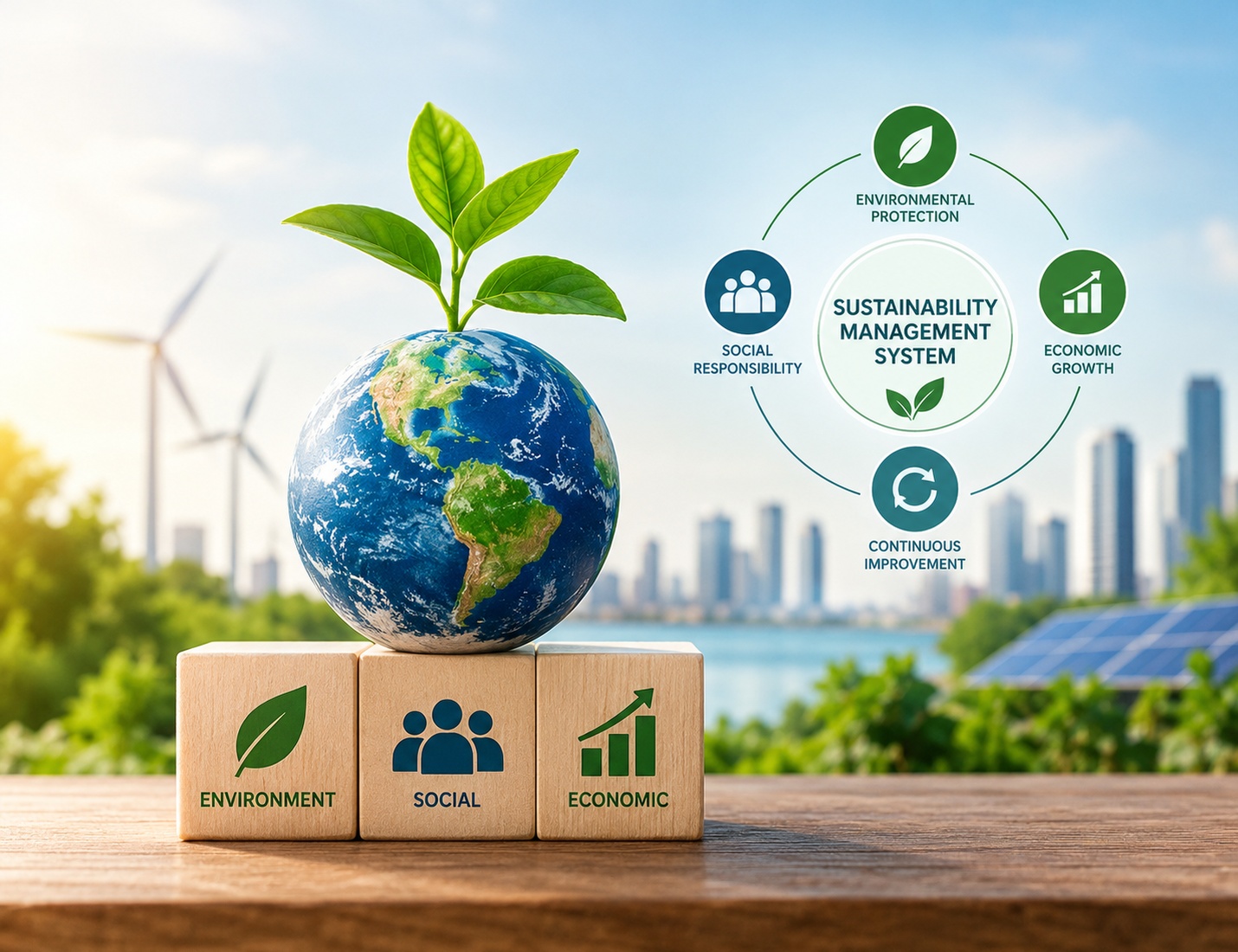
A is a structured framework that helps an organization integrate environmental, social, and economic considerations into its decision-making, policies, processes, and day-to-day activities.
Its purpose is to support long-term organizational performance while reducing negative environmental and social impacts. It also helps businesses use resources responsibly, manage sustainability-related risks, and identify opportunities for improvement.
Sustainability management involves developing policies, assigning responsibilities, setting objectives, measuring performance, reviewing progress, and continually improving how an organization manages its environmental, social, and economic responsibilities.
Sustainable development focuses on creating economic and social progress while protecting the environment and conserving natural resources. Sustainability management provides organizations with practical systems and processes to support this goal.
This can include reducing energy and water consumption, managing waste effectively, lowering emissions, improving resource efficiency, adopting cleaner technologies, supporting employee well-being, and considering long-term impacts when making business decisions.
Businesses, employees, communities, suppliers and other stakeholders can benefit when sustainability is integrated into everyday decisions and operations.
Effective sustainability management helps organizations use resources responsibly, support sustainable development and strengthen long-term business performance.
Use energy, fuel, water, raw materials and other resources more efficiently to minimize waste, pollution-related impacts and unnecessary operational expenses.
Support the protection of natural resources, ecosystems, communities and future economic opportunities through responsible environmental and social practices.
Improve competitiveness, business continuity, innovation, operational resilience and the ability to respond to changing market expectations.
Reduce greenhouse gas emissions, prevent pollution, minimize waste, conserve water and energy, and protect natural resources.
Consider worker health and safety, fair employment practices, diversity and inclusion, ethical conduct, community engagement and responsible supply chains.
Identify applicable requirements, maintain records, monitor compliance and prepare for climate, resource, supply-chain and regulatory challenges.
Sustainability management enables organizations to manage environmental, social and economic issues in a coordinated and systematic way.
These principles help organizations integrate sustainability into their policies, operations and everyday decisions.
Develop suitable policies, objectives, strategies and action plans after identifying significant environmental, social and economic impacts.
Consider energy-efficient equipment, renewable energy, water-saving systems, waste recovery, emission controls, cleaner production and digital monitoring tools.
Bring management principles and environmental policies together, considering resource availability, social impacts and long-term organizational resilience.
Recognize how water, energy, land, raw materials, biodiversity and healthy ecosystems support business and society.
Reduce consumption, improve efficiency, reuse materials, recycle resources and adopt renewable alternatives where practical.
Manage resource extraction and consumption carefully so ecosystems can regenerate, particularly water resources, forests, fisheries, agricultural land and biodiversity.
A well-designed Sustainability Management System can support consistent improvement across business operations.
Sustainability management should not be viewed as a one-time project or an activity separate from normal business operations. Its greatest value comes when environmental, social and economic considerations become part of routine planning and decision-making.
Organizations can begin with practical measures such as improving energy efficiency, reducing waste, conserving water, monitoring emissions, engaging employees, evaluating suppliers and setting measurable sustainability objectives. Over time, these activities can develop into a comprehensive Sustainability Management System that supports responsible growth and continual improvement.
Answers to common questions about sustainability management systems and their role in organizations.
A Sustainability Management System provides organizations with a structured framework for managing environmental, social and economic responsibilities. It helps businesses integrate sustainability into policies, operations, decision-making, performance monitoring and long-term planning.
Through responsible resource use, pollution prevention, social responsibility, sustainable technologies and continual improvement, organizations can reduce their environmental impact while strengthening operational efficiency and resilience.
As sustainability continues to influence regulations, customer expectations, supply chains, investment decisions and business strategies, a systematic approach can help organizations respond to future challenges while contributing to sustainable development.