Control of Substances Hazardous to Health (COSHH)
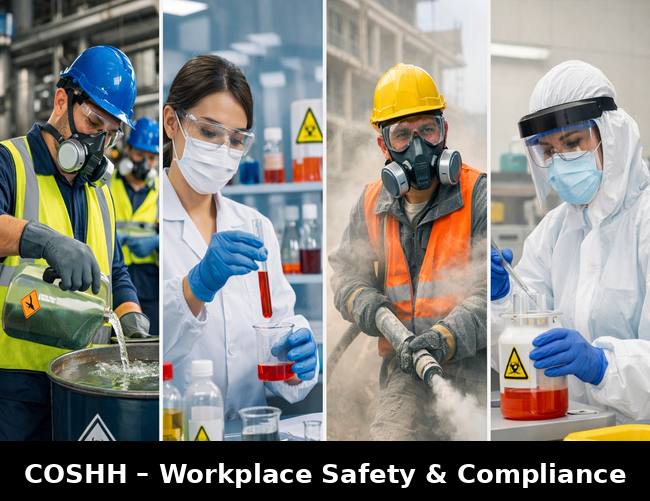
Control of Substances Hazardous to Health (COSHH) plays a critical role in protecting employees from health risks arising due to exposure to hazardous substances. Many industries such as manufacturing, construction, laboratories, cleaning services, food processing, and healthcare, regularly handle chemicals, fumes, dusts, vapours, and biological agents that can cause serious short and long-term health effects if not properly managed.
Hazardous substances under COSHH include chemicals, fumes, mists, dusts, gases, vapours, biological agents, and even some naturally occurring materials such as flour dust or silica. Exposure to these substances can lead to skin irritation, respiratory diseases, occupational asthma, chemical burns, poisoning, and long-term illnesses such as cancer. The risks are often intensified due to poor ventilation, inadequate storage, improper handling, lack of training, or failure to use appropriate personal protective equipment (PPE).
The foundation of effective COSHH management begins with hazard identification and risk assessment. Employers must identify all hazardous substances used or generated at the workplace and assess how workers may be exposed through inhalation, skin contact, ingestion, or injection. Safety Data Sheets (SDS) must be reviewed to understand health effects, exposure limits, incompatibilities, and emergency measures. This assessment helps in determining the severity of risk and selecting suitable control measures. Reference international regulation such as The Control of Substances Hazardous to Health Regulations, 2002, UK.
A robust COSHH control strategy follows the hierarchy of controls, which includes:
❖ Elimination or substitution of hazardous substances wherever feasible.
❖ Engineering controls such as local exhaust ventilation and enclosed systems.
❖ Administrative controls including safe work procedures, labeling, training, and restricted access.
❖ Use of suitable PPE such as gloves, goggles, respirators, and protective clothing as a last line of defense.
Safe storage and handling are equally essential under COSHH. Hazardous substances must be clearly labeled, stored in compatible containers, segregated based on chemical properties, and kept away from ignition sources. Spill kits, emergency showers, eyewash stations, and first-aid facilities should be readily available, and employees must be trained to respond effectively to spills, leaks, or accidental exposure.
Health surveillance is another important aspect of COSHH where required. Regular monitoring helps detect early signs of work-related ill health, ensuring timely intervention before conditions worsen. Periodic reviews of COSHH assessments are also necessary, especially when new substances are introduced, processes change, or incidents occur.
At EHS Management Consultants, we support organizations in implementing effective COSHH systems through hazard identification, COSHH risk assessments, SDS reviews, training, and compliance audits. By understanding the nature of hazardous substances and applying appropriate control measures, organizations can significantly reduce health risks, ensure regulatory compliance, and foster a safer, healthier workplace. Ultimately, proactive COSHH management is not just a legal obligation—it is a commitment to safeguarding people and sustaining business operations responsibly.